Blog steps
Steps to Miles: How Many Steps in a Mile (by Height)
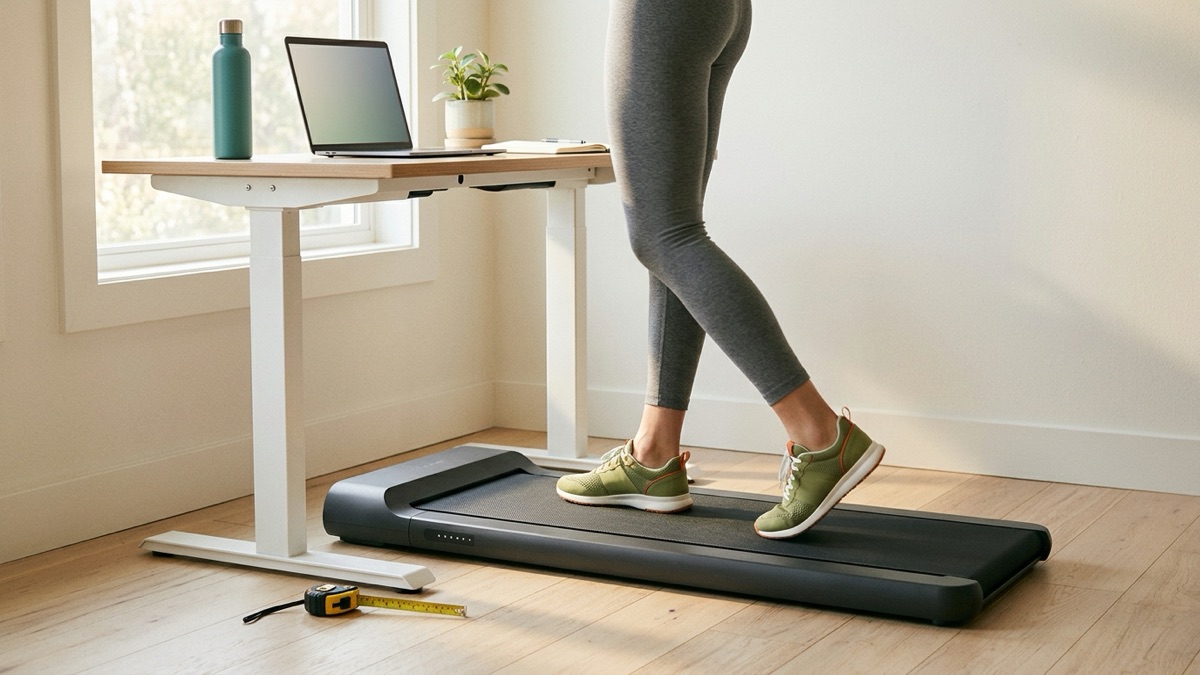
Your pad says you walked 1.6 miles. Your watch says 2,100 steps, which cannot be right because your hands were on the keyboard the whole time. Which number is the truth, and how do they even relate? The answer is one measurement you can take in sixty seconds.
Quick answer
Most adults take about 2,000 to 2,500 steps per mile at an everyday walking pace. The round figure of 2,000 comes from a cadence of 100 steps a minute at 3 mph, where a mile takes 20 minutes. Shorter people and slower speeds mean more steps per mile; taller people and brisker speeds mean fewer. A step length of about 0.41 times your height gives a good personal estimate.
Key takeaways
- A mile is 1,609 meters, so steps per mile is simply that distance divided by your step length.
- The common 2,000 steps per mile figure is arithmetic: 100 steps a minute, which a 2011 research paper on step counts treats as the floor for moderate intensity, for the 20 minutes a mile takes at 3 mph.
- A widely used pedometer convention puts step length at 0.415 times height for men and 0.413 for women, which gives roughly 2,550 steps per mile at 5 ft 0 in and 2,120 at 6 ft 0 in.
- 10,000 steps is therefore about 4 to 5 miles, not a fixed distance.
- On a walking pad, speed multiplied by time gives distance exactly. Steps are the estimate, not the other way round.
Where does "2,000 steps per mile" come from?
It is a tidy piece of arithmetic rather than a measured fact. In a 2011 paper summarizing step-count research in the International Journal of Behavioral Nutrition and Physical Activity, Tudor-Locke and colleagues describe 100 steps a minute as "a reasonable floor value indicative of moderate intensity walking" and note that 30 minutes at that cadence "produces a minimum of 3,000 steps". A brisk 3 mph walk covers a mile in 20 minutes, and 20 minutes at 100 steps a minute is 2,000 steps. That is the whole story.
The same paper puts typical US adults at roughly 5,100 steps a day by pedometer in one study and about 6,500 in national accelerometer data adjusted to a pedometer scale. If you have ever wondered why 10,000 feels like a stretch on a desk day, that gap is the reason, and it is exactly the gap a walking pad is good at closing. Our guide to how many steps a day goes through the step bands the paper proposes, from under 5,000 (sedentary) to 10,000 and beyond (active).
How many steps are in a mile at your height?
Steps per mile is distance divided by step length, and step length tracks height. The most common pedometer convention, documented in a 2024 overview of pedestrian navigation methods, estimates step length as a fixed share of height: 0.415 for men and 0.413 for women. The two numbers are so close that we use 0.414 for everyone in the table below. Treat it as a starting estimate; the section after this shows how to replace it with your own.
| Height | Step length (0.414 x height) | Steps per mile | 10,000 steps in miles |
|---|---|---|---|
| 5 ft 0 in | about 25 in (63 cm) | about 2,550 | about 3.9 |
| 5 ft 2 in | about 26 in (65 cm) | about 2,470 | about 4.0 |
| 5 ft 4 in | about 26.5 in (67 cm) | about 2,390 | about 4.2 |
| 5 ft 6 in | about 27 in (69 cm) | about 2,320 | about 4.3 |
| 5 ft 8 in | about 28 in (72 cm) | about 2,250 | about 4.4 |
| 5 ft 10 in | about 29 in (74 cm) | about 2,190 | about 4.6 |
| 6 ft 0 in | about 30 in (76 cm) | about 2,120 | about 4.7 |
| 6 ft 2 in | about 30.5 in (78 cm) | about 2,070 | about 4.8 |
Notice that the table runs higher than the 2,000 rule of thumb for everyone under about 6 ft 4 in. That is because 0.41 times height describes an everyday pace, while the 2,000 figure assumes a brisk 3 mph with a long stride. Both are right about different walks, which is the point of the next section.

Why does speed change steps per mile?
Because you do two things when you speed up: you take steps a little more often, and you make each one longer. Step length grows faster than cadence does, so a brisk mile uses fewer steps than a slow one. A 2008 study in ACSM's Health and Fitness Journal set out to measure exactly this, counting steps for a mile at a range of walking and running speeds so that trainers could estimate how much extra distance a client needs to reach 10,000 steps. The general pattern it describes is the one every pedometer user notices: the faster the mile, the shorter the count.
Age matters a little too. A 2001 gait study in healthy adults found that older walkers chose slower speeds and shorter strides than younger ones, while cadence was not associated with age, height or body weight. In plain terms, the number of steps you take per minute is fairly personal and stable; the length of each step is what changes with height, speed and the years.
For pad walkers this has a practical consequence. The same 30 minutes at 2 mph and at 3 mph are not the same number of steps, and neither is the number your watch guesses. Our guide to how many steps are in 30 minutes of walking lays out the combinations by speed.
How do you measure your own steps per mile?
The table above is an estimate for an average person of your height. You are not average, and you do not need to be, because the measurement takes a minute.
- Set your usual speed on the pad, the one you actually walk at while working. Let the belt settle.
- Count every step for exactly 60 seconds. Count one foot and double it if that is easier.
- Work out the minutes per mile at that speed: 60 divided by your mph. At 2 mph that is 30 minutes, at 2.5 mph 24 minutes, at 3 mph 20 minutes, at 3.5 mph about 17 minutes.
- Multiply. Steps per minute times minutes per mile is your steps per mile at that speed.
Example: 108 steps a minute at 2.5 mph gives 108 x 24, about 2,590 steps per mile. Do it again at your workout speed, because the number will be different. Write both down; they are more useful than anything a wrist can infer.
Try it
The walking pad calories calculator takes your height along with speed, incline and minutes, and shows the step estimate, the cadence it implies and the distance, with the arithmetic printed next to the result so you can compare it with your own count.
How do steps, miles and minutes connect on a walking pad?
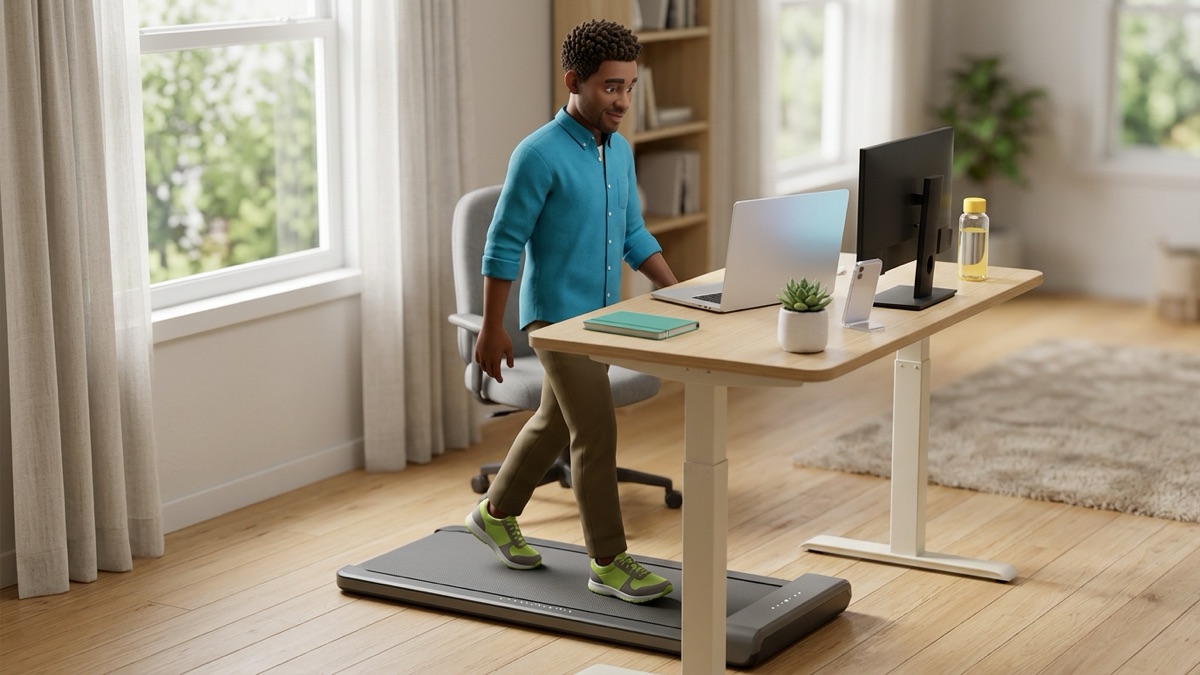
A walking pad is an unusually honest machine about one thing: distance. It knows the belt speed, you know the time, and speed times time is distance with no estimation involved. Two miles at 2.5 mph takes 48 minutes whether you are 5 ft 1 in or 6 ft 3 in. Steps are the derived number: distance divided by your step length.
That is the opposite of how a watch works, and it is why pad walkers so often see a mismatch. A wrist tracker counts arm swings and infers steps. Rest your hands on a desk or a keyboard and the swings stop, so the count stalls while the belt keeps moving. The guide to why your watch undercounts on a walking pad covers the fixes, and how to track walking pad steps shows how to log a session from speed and time instead.
A few conversions worth keeping in your head, using the 5 ft 6 in row of the table:
| What you walked | Distance | Steps (5 ft 6 in) | Time at 2.5 mph |
|---|---|---|---|
| 1 mile | 1.0 mi | about 2,320 | 24 minutes |
| 30 minutes at 2.5 mph | 1.25 mi | about 2,900 | 30 minutes |
| 10,000 steps | about 4.3 mi | 10,000 | about 103 minutes |
| 5,000 steps | about 2.2 mi | 5,000 | about 52 minutes |
The 10,000-step row is the one that surprises people: at a typing-friendly 2.5 mph it is more than an hour and a half of belt time, which is why most pad walkers aim to add steps to a day rather than replace the whole day. See 10,000 steps in miles for the time at other speeds and miles to steps for the reverse conversion.
Tip
If you want one number to track, make it minutes or miles, not steps. They come straight from the pad, they do not depend on where your hands are, and the CDC's weekly guideline is written in minutes anyway.
Does step count tell you anything about intensity?
Only indirectly. The CDC defines moderate intensity as 3 to 5.9 METs and uses walking briskly at 2.5 mph or faster as its example, and the step research treats 100 steps a minute as a reasonable floor for moderate walking. So a cadence above 100 is a decent sign you are in the moderate band, but the step total for a day says nothing about how fast any of them were. Ten thousand slow steps spread over a day and 3,000 brisk ones in half an hour are both worth having, and they are different things.
Heads up
Any plan that leans on step counts should still respect your body. Start with short sessions at a low speed, keep the pad on a flat floor with cords clear of your feet, wear shoes with grip, and stop if you feel dizzy, short of breath or in pain. If you have a heart condition, joint or balance problems, or are pregnant, talk with your doctor before adding a daily walking target.
The takeaway
A mile is about 2,000 to 2,500 steps for most adults, and your own figure depends on your height and how fast you walk. Use the table to get close, spend one minute counting to get exact, and on a walking pad remember which direction the math runs: speed and time give you distance, and distance gives you steps. The PadStride app, coming to Android first, will do that conversion for every session from the speed you set on the pad.
PadStride guides explain and estimate; they do not promise weight loss or any health result. Calorie figures come from a published equation and carry its limits, and nothing here is medical advice. If you have a heart condition, joint or balance problems, or are pregnant, talk with your doctor before you start, keep the speed low while you type, and stop if you feel dizzy, short of breath or in pain.
Questions walkers ask
How many steps are in a mile?
About 2,000 to 2,500 for most adults walking at an everyday pace. The 2,000 figure comes from a cadence of 100 steps a minute at 3 mph; shorter walkers and slower speeds push the count up, taller walkers and faster speeds pull it down.
How many miles is 10,000 steps?
Roughly 4 to 5 miles. Using a step length of 0.41 times height, 10,000 steps is about 3.9 miles for someone 5 ft 0 in, 4.3 miles at 5 ft 6 in and 4.7 miles at 6 ft 0 in.
How do I find my own steps per mile?
Count your steps for exactly one minute at your usual pad speed, then multiply by the minutes a mile takes at that speed (60 divided by mph). At 2.5 mph a mile takes 24 minutes, so 100 steps a minute means 2,400 steps a mile.
Does walking faster change steps per mile?
Yes. Faster walking lengthens each step, so a mile takes fewer steps. Cadence rises too, but not as much as step length, which is why a brisk mile can be a few hundred steps shorter than a slow one.
Why does my watch count fewer steps on a walking pad?
Wrist trackers infer steps from arm swing. When your hands rest on a desk or keyboard, many steps are never counted. Speed multiplied by time gives distance exactly, and distance divided by your step length gives a better step count than the watch.
Where these facts come from
- Tudor-Locke et al., How many steps/day are enough? for adults, International Journal of Behavioral Nutrition and Physical Activity 2011: pmc.ncbi.nlm.nih.gov/articles/PMC3197470/
- Klein, Pedestrian Inertial Navigation: An Overview of Model and Data-Driven Approaches, arXiv 2024 (the height-based step length model): arxiv.org/html/2407.21676v1
- Hoeger et al., One-Mile Step Count at Walking and Running Speeds, ACSM's Health and Fitness Journal 2008 (abstract): scholarworks.boisestate.edu/kinesiology_facpubs/47/
- Samson et al., Differences in gait parameters at a preferred walking speed in healthy subjects due to age, height and body weight, Aging 2001 (abstract): pubmed.ncbi.nlm.nih.gov/11292147/
- CDC: How to Measure Physical Activity Intensity: www.cdc.gov/physical-activity-basics/measuring/index.html